 Toolvia
What each digit in a VIN means
A VIN looks like random letters and numbers, but every position has a job. Once you know the pattern, you can read the basics of almost any car built since 1981 in a few seconds.
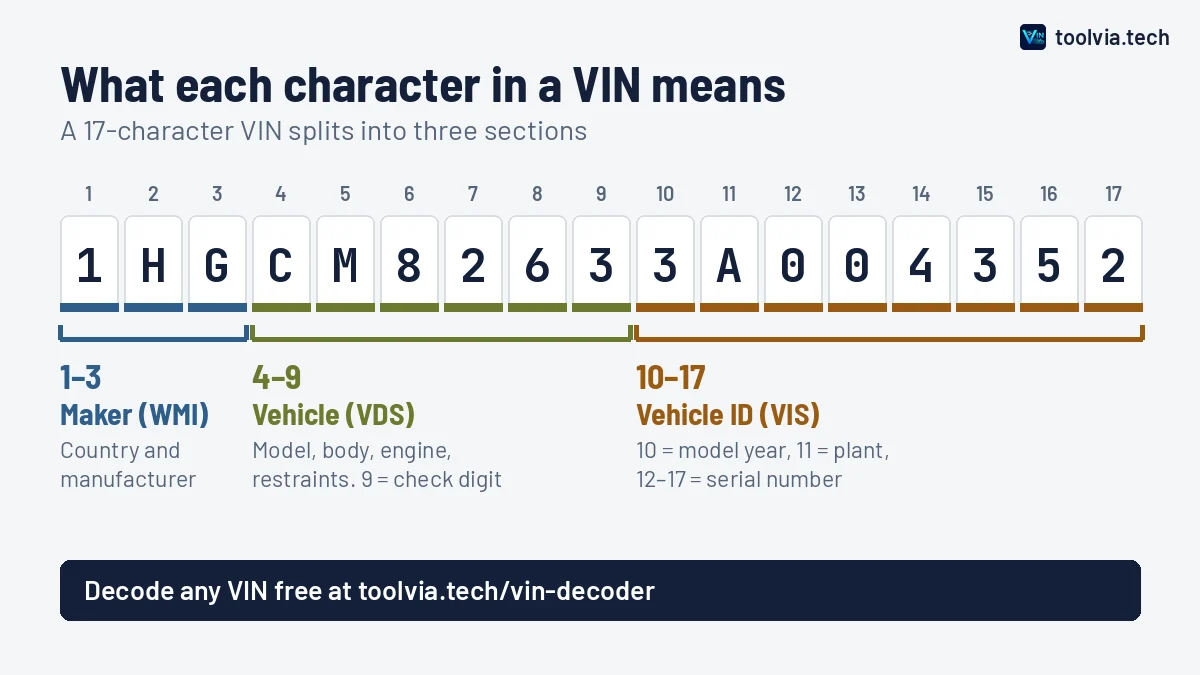
The short answer: characters 1 to 3 identify the manufacturer and country, 4 to 8 describe the vehicle (model, body, engine, restraints), 9 is a check digit that catches typos, 10 is the model year, 11 is the assembly plant, and 12 to 17 are the vehicle’s serial number.
Every car, truck, SUV and motorcycle sold in the United States since the 1981 model year has a 17-character Vehicle Identification Number. The format is set by federal rules, so a Ford, a Toyota and a BMW all follow the same layout, even though each company fills in the middle section its own way.
The 17 positions at a glance
| Position | What it tells you | Example (1HGCM82633A004352) |
|---|---|---|
| 1 | Country or region where the vehicle was built | 1 = United States |
| 2 | Manufacturer | H = Honda |
| 3 | Vehicle type or division | G = Honda passenger car |
| 4–8 | Model, body style, engine and restraint system | CM826 |
| 9 | Check digit | 3 |
| 10 | Model year | 3 = 2003 |
| 11 | Assembly plant | A |
| 12–17 | Production serial number | 004352 |
The VIN can never contain the letters I, O or Q. They’re too easy to mix up with 1 and 0, so if you think you see one, it’s almost certainly a number.
Characters 1–3: the World Manufacturer Identifier
The first three characters together are called the World Manufacturer Identifier, or WMI. They tell you who made the vehicle and, through the first character, roughly where.
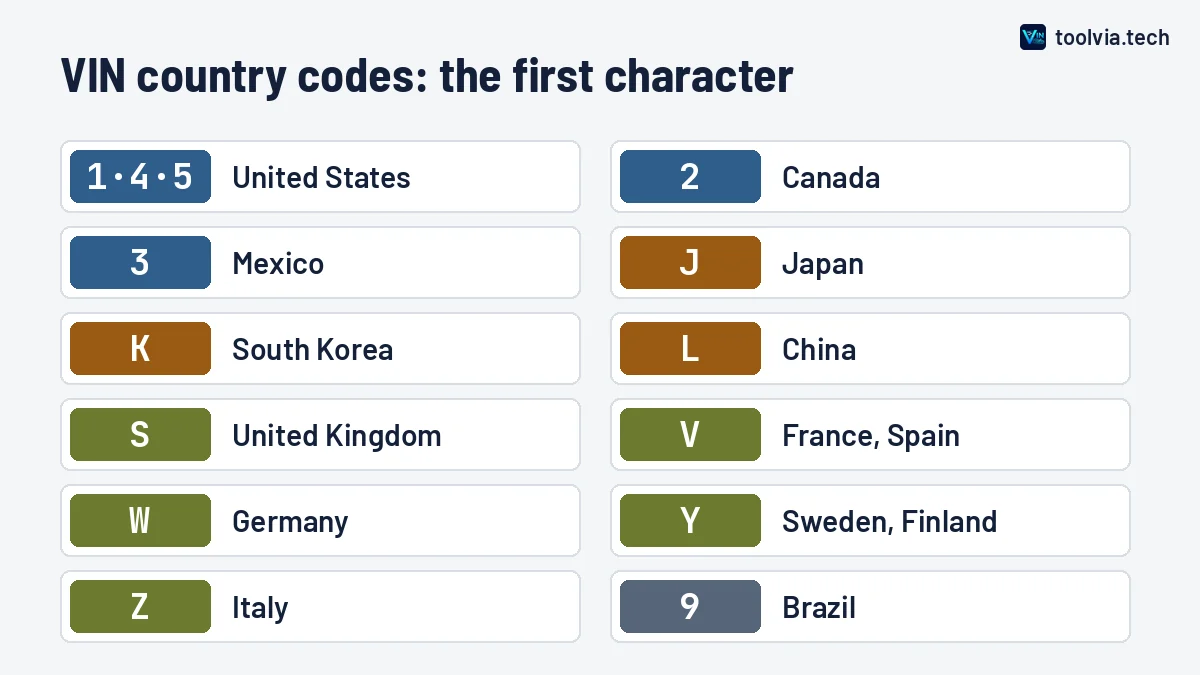
The first character is the country or region. 1, 4 and 5 mean the United States, 2 is Canada, 3 is Mexico, J is Japan, K is South Korea, W is Germany and Z is Italy. Our VIN country codes guide has the full list.
The second and third characters narrow it down to a specific manufacturer and often a division or vehicle type. For example, Ford uses 1FT for trucks and 1FM for SUVs, while BMW uses WBA for cars and WBS for its M models. A few very small manufacturers use a 9 in the third position and add their own code in positions 12 to 14.
Characters 4–8: the Vehicle Descriptor Section
This is the part each company designs for itself, so it’s the hardest to read without a decoder. Together with the check digit, these positions make up the Vehicle Descriptor Section. Manufacturers use them to record things like:
- the model or car line
- the body style, such as sedan, coupe or crew cab
- the engine
- the type of restraint system, such as airbags and seat belts
- for trucks, the weight class and brake system
Some brands follow a predictable pattern. Ford and GM, for example, use the 8th character for the engine code. Tesla puts the model letter in position 4. But there’s no universal rule, which is why a decoder that checks the manufacturer’s own data is so useful.
Character 9: the check digit
The 9th character is a security and accuracy check. It’s calculated from all the other characters using a formula set by the U.S. Department of Transportation. If someone mistypes a VIN, or makes one up, the check digit usually won’t match.
Here’s how it works. Each letter is converted to a number (A=1, B=2, and so on, with a few skips), each position gets a fixed weight, and you multiply them together.
| Position | Character | Value | Weight | Product |
|---|---|---|---|---|
| 1 | 1 | 1 | 8 | 8 |
| 2 | H | 8 | 7 | 56 |
| 3 | G | 7 | 6 | 42 |
| 4 | C | 3 | 5 | 15 |
| 5 | M | 4 | 4 | 16 |
| 6 | 8 | 8 | 3 | 24 |
| 7 | 2 | 2 | 2 | 4 |
| 8 | 6 | 6 | 10 | 60 |
| 9 | 3 | 3 | 0 | 0 |
| 10 | 3 | 3 | 9 | 27 |
| 11 | A | 1 | 8 | 8 |
| 12 | 0 | 0 | 7 | 0 |
| 13 | 0 | 0 | 6 | 0 |
| 14 | 4 | 4 | 5 | 20 |
| 15 | 3 | 3 | 4 | 12 |
| 16 | 5 | 5 | 3 | 15 |
| 17 | 2 | 2 | 2 | 4 |
Add up the products and you get 311. Divide by 11 and the remainder is 3, which matches the 9th character. If the remainder is 10, the check digit is the letter X. The weight for position 9 itself is zero, so it doesn’t affect its own calculation.
You don’t need to do this by hand. The Toolvia VIN decoder checks it automatically as you type.
Vehicles built for markets outside North America don’t always use the check digit. A mismatch on a European-market car isn’t automatically a red flag, but on a US-market vehicle it usually means a typo.
Character 10: the model year
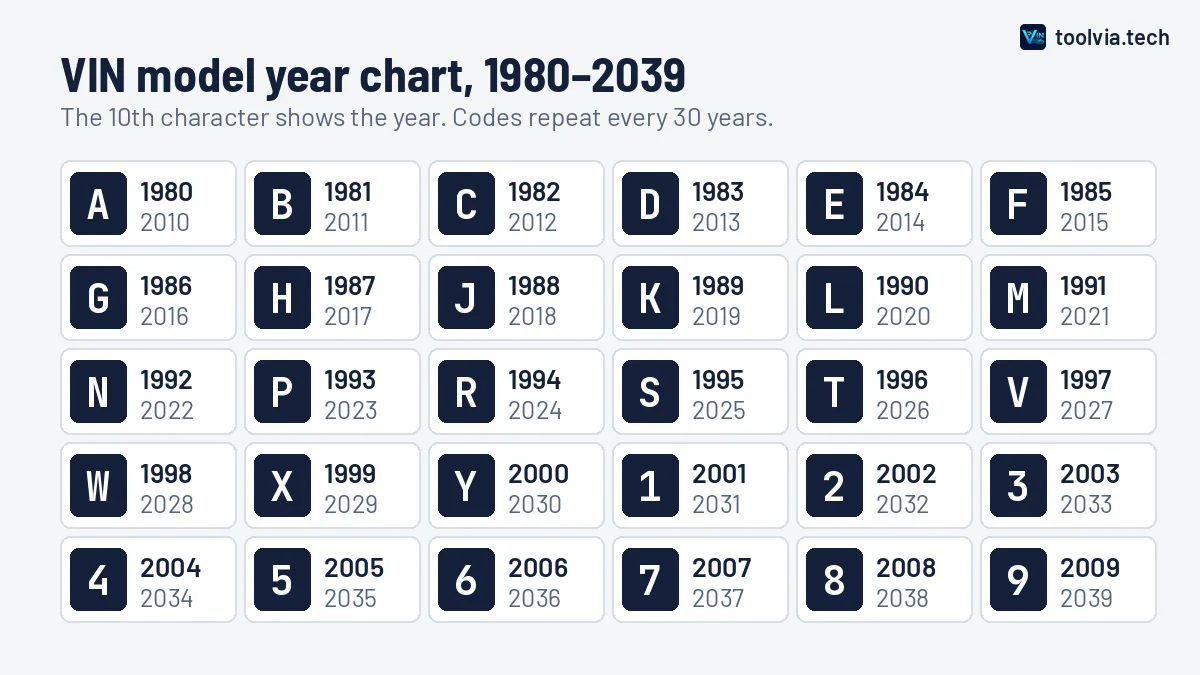
The 10th character is the model year. The codes run through the alphabet (skipping I, O, Q, U, Z and the number 0) and then the digits 1 to 9, which gives 30 codes before they repeat. So A means 1980 or 2010, Y means 2000 or 2030, and 3 means 2003 or 2033.
For cars, SUVs and light trucks sold in North America there’s a simple way to tell which cycle it is: if the 7th character is a number, the year is between 1980 and 2009, and if it’s a letter, the year is between 2010 and 2039. The VIN year chart lists every code.
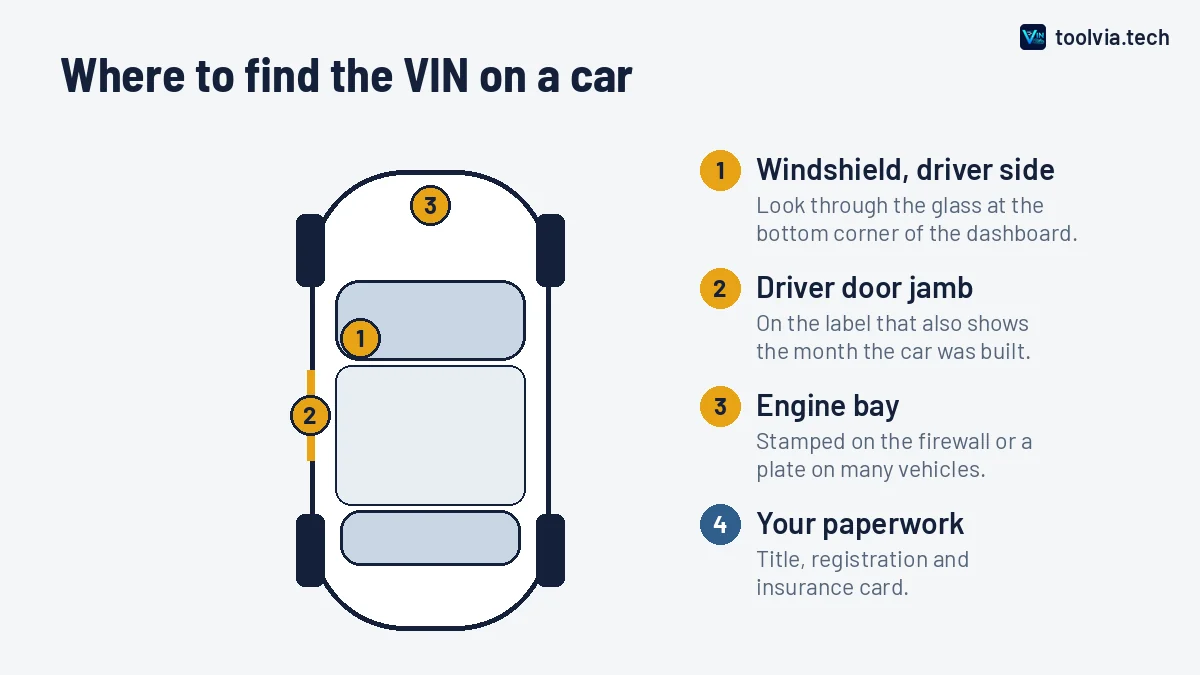
Keep in mind that the model year isn’t always the year the vehicle was built. A 2025 model can roll off the line in mid-2024. The build month and year are printed on the label in the driver’s door jamb.
Character 11: the assembly plant
The 11th character identifies the factory. Each manufacturer has its own plant codes, so an F on a Tesla means Fremont, California, while an F on another brand means something else entirely. The decoder looks the plant up for you and shows the city and country.
Characters 12–17: the serial number
The last six characters are the production sequence number. They make each VIN unique, so two cars with the same model, year and options from the same plant will still have different VINs. Manufacturers that build fewer than 1,000 vehicles a year use positions 12 to 14 as part of their identifier and only 15 to 17 as the serial number.
What a VIN can’t tell you
A VIN describes how a vehicle was built. It doesn’t contain its history. You won’t find accidents, mileage, owners or title brands like salvage or flood in the VIN itself. Those come from separate records that history report companies collect using the VIN as a key.
What you can get for free is the build information, open safety recalls and owner complaints, all from NHTSA. That’s what our decoder shows.
Frequently asked questions
How many digits does a VIN have?
Vehicles from the 1981 model year onward have exactly 17 characters. Older vehicles used shorter serial numbers that varied by manufacturer.
Which digit in a VIN is the year?
The 10th character. Use the VIN year chart to match the code to a year, and the 7th character to tell which 30-year cycle it falls in.
Which digit is the engine code?
It depends on the brand. Ford and GM use the 8th character, but other makers put engine details elsewhere in positions 4 to 8. A decoder reads it correctly for each brand.
Why doesn’t a VIN use I, O or Q?
To avoid confusion with 1 and 0. The letters U and Z, and the number 0, are also never used in the year position.
Keep reading
Find any vehicle’s model year from the 10th character of its VIN. A complete chart from 1980 to 2039, plus the simple…
The quickest places to find a VIN on a car, truck, motorcycle, trailer or RV, plus which documents show it and what to…
The first character of a VIN shows where a vehicle was built. See the full list of VIN country codes, how the second…